
Metacognition and Chess

Updated: Aug 5
The importance of metacognition
My favourite definition of metacognition for primary-aged children is children being aware of their thinking. To me, this is one of the missing pieces of the national curriculum. Anyone who has tried to learn a new discipline, language or skill will quickly realise the importance approaching tasks in ways that are effective and time-efficient.
Children who use metacognition may sacrifice some time spent solving a problem, as they think about the task, their approach and how they are going to be successful. I say 'sacrifice', when in reality, children will likely gain this time back through pursuing an efficient and effective approach to the task at hand.
The primary curriculum for computing mentions 'computational thinking' as a requirement for key stages 1 and 2. Computational thinking is an example of metacognition. It requires children to be aware of the steps for solving a computing task, including breaking the problem down, looking for patterns, abstracting key information, forming and testing an algorithm to solve the problem, fixing errors and looking for generalisation from similar problems.
In primary Maths, there is an emphasis on metacognition, particularly when approaching primary questions. Strategies such as 'RUCSAC' (Read, underline, choose, solve, answer, check) are metacognitive, making children aware of the process, as well as the answer. Primary English teaches children to spot patterns across different forms of writing and subjects like PE encourage children to be aware of ways to move and react in certain situations. My experience of teaching with some truly excellent teachers has allowed me to witness metacognition in lessons across the primary curriculum, but I would still love to see a greater emphasis placed on children's thinking, perhaps codified into a common metacognitive practice across subjects.
I have written about the benefits of teaching chess to primary aged children before. The more I play chess with children in school, the more I appreciate its benefits. To me, chess is to thinking as running is to physical health. Perhaps this is why the Republic of Armenia has made chess a required part of the primary curriculum since 2011.
In this post, we explore some of the specific metacognitive benefits to children in learning to play chess.
Having a goal
In the most successful games of chess I play, I usually have some idea of what I am aiming for. This can be an idea for a checkmate, or a broader strategy of trading less valuable pieces for an opponent's more valuable pieces or a better overall position. Conversely, games where I do not have a goal in mind often result in defending against an opponent's plan, or failing to spot an plan completely until it is too late.
Of course, to play chess well, it is as important to be aware of your opponent's goals as you own. Good chess players play two games of chess: their own and their opponent's. One of the things I try hard to teach children about chess at school is to spend just as much time considering your opponent's best move as your own.
How does having a goal translate into metacognition across the curriculum?
Children should have an idea of where their learning fits into a 'big picture'. This motivates them to persevere with challenging tasks and helps them to see the value in what they are learning. It might be that a particular skill is being practised with a view to it being used in a showcase event, or final project. The opposite of this, learning without a goal, is somewhat akin to aimlessly moving pieces around on a chessboard.
Awareness of the whole picture
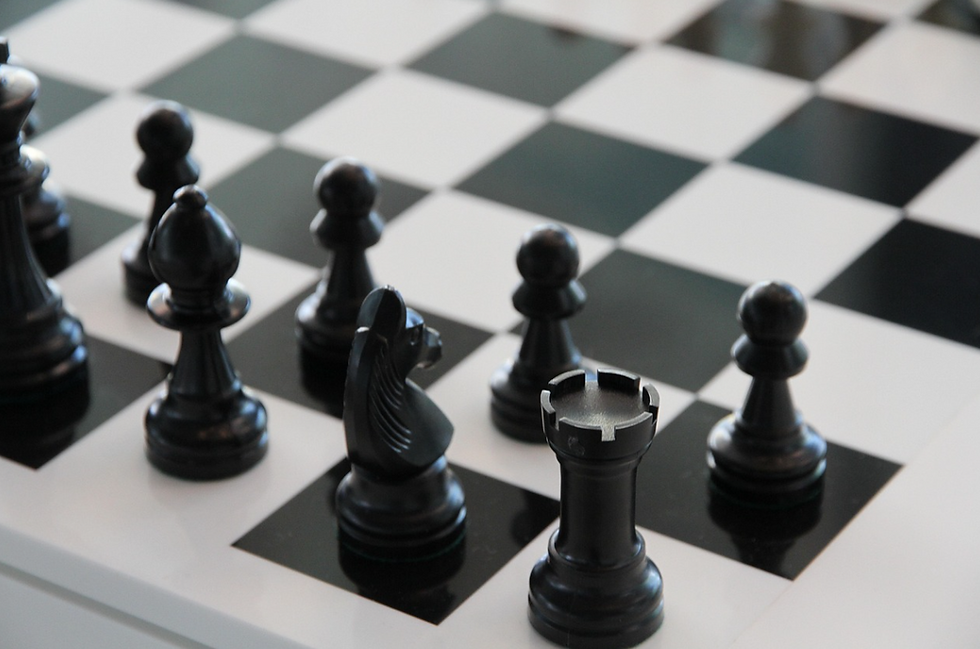
In chess, it is easy to become so focused on one area of the chessboard that a threat, or opportunity is overlooked elsewhere. Teaching children to 'scan the whole board' before making moves helps guard against this.
Across the primary curriculum, it is just as important for children to develop an awareness of the whole picture of their learning. In English lessons, children can spend their entire time writing one aspect of a story, to neglect other required parts of their writing. In Maths, children can become side tracked on the wrong information, or aspects of a problem that are not required.
In computing, abstraction is a good defence against these types of pitfalls. Abstraction teaches children to 'rule out' unnecessary parts of a task and focus on key information. This is the sort of approach that is worth practising explicitly with children and which saves them time in the long term.
Study
Success in chess comes from far more than playing games. This is perhaps more obvious in chess than in disciplines like painting and sport, although I would argue that this principle holds just as strongly in disciplines across the whole curriculum.
Success in chess comes from a mixture of study, solving puzzles to reinforce pattern spotting and playing games to apply knowledge. Players who simply play game after game will quickly find that they have reached a ceiling and are losing as many games as they are winning. A ratio of about 40% playing to 60% studying, through watching videos and reading, and solving puzzles is what I would recommend for improving at chess.
I have mentioned that this approach is relevant to other subjects and it is through teaching children about metacognition that they realise the value in this. Children learn that they can improve at a subject through studying aspects of it effectively, examining examples of success and replicating these. They learn that success is not something inherent, but can be achieved through effective, targeted practice.
Patience and resilience
Success in chess often comes as a result of patiently waiting for an opportunity, or carefully building and adapting a plan. In chess, it is always important to remember that you are playing against another human, and that all humans eventually make mistakes!
This patience translates well to subjects across the curriculum. Children can be taught that success is usually not achieved immediately and often requires build up, planning and perseverance.
Lateral thinking
Lateral thinking is fascinating to explore with children. Presenting them with opportunities to see solutions other than the most obvious is empowering and often, deeply rewarding. This is also a key part of chess, connected to 'scanning the whole board' as mentioned above.
Children can be taught that even if they do not know the answer, attempting the question can often lead to them discovering wrong answers, or often, a solution or the right answer itself.

Pattern spotting
In chess, pattern spotting allows players to make the best moves in certain situations. It also minimises cognitive load and importantly, saves time in chess games. In chess, players can utilise patterns through learning openings and defences to openings. In effect, this can save players from having to think about the best move for at least the first three or four moves, of course dependent also on the moves their opponent makes. Players can learn common checks, checkmates, forks and traps. They can learn the mantra 'check, capture, attack', which is not a pattern of moves, but a pattern of play, teaching players to proritise their moves accordingly.
Children can learn and apply pattern spotting across the curriculum. As in chess, this can have the effect of enabling them to succeed, reduce their cognitive load and increase their confidence. Pattern spotting in writing helps children recognise useful sentence structures, sentence starters and compositional techniques. In Maths, children can recognise that there are a finite number of questions about a given topic and that by following a procedure, they can be successful and save their thinking for more advanced application. In sport, children can learn patterns of play, techniques and strategies, increasing their success in individual and team sports.
Concluding thoughts
Chess is a good vehicle for teaching and training metacognition in schools. Many of the qualities of successful chess are applicable to metacognition across the primary curriculum. In a sense, chess 'distills' thinking and metacognition, since without developing these skills, success and progress and difficult in a way that is perhaps not as obvious in other disciplines.
Whether or not chess is used as a vehicle for teaching and training metacognition in schools, time spent developing metacognition in primary and secondary school can develop children's confidence, agency and success in their learning. It would be fascinating to develop metacognition in primary schools to the point where children could talk about and use a common approach across subjects.


