
From tablets to textbooks: why Nordic countries are prioritising traditional methods

Updated: Aug 5
The great reset
For over a decade, Nordic countries invested heavily in digital technology for schools.

In Sweden, data from the Swedish National Agency for Education, (Skolverket) shows the scale of this rollout. In 2016, in preschools, there were 8.2 children per computer or tablet, compared to 12.5 four years earlier. In primary schools, in 2016, there were 1.8 children per device, compared to 3.0 in 2012. In secondary schools by 2016, children had approximately 1:1 access, with 1.0 children per device compared to 1.3 in 2012. (source)
In Norway, the Monitor Skole Report (source) stated that in 2016, school leaders reported an average of 3.6 students per device across all mandatory school years. By 2019, Monitor Skole reported that 80% to 90% of lower secondary children had their own dedicated device. Primary children were still frequently sharing, averaging 2-3 children per device.
In Denmark, students ranked highest on an OECD report which asked how frequently students used digital resources to write or edit text or a school assignment. (source). 80% of students in Denmark reported using digital resources at least once a week to wrote or edit text for a school assignment and 75% of students in Denmark reported using digital devices at least once a week to find information about a real-world phenomenon or dilemma.
Yet coinciding with these developments, all three countries experienced declines in PISA score testing in mathematics, reading and science.
The graphs below show results in mathematics, reading and science, comparing Norway, Sweden and Denmark to Korea - a country that usually performs well in PISA testing, and the UK.
OECD PISA Database, 2022 - Average proficiency in mathematics, reading and science from 2006 to 2022
(source)

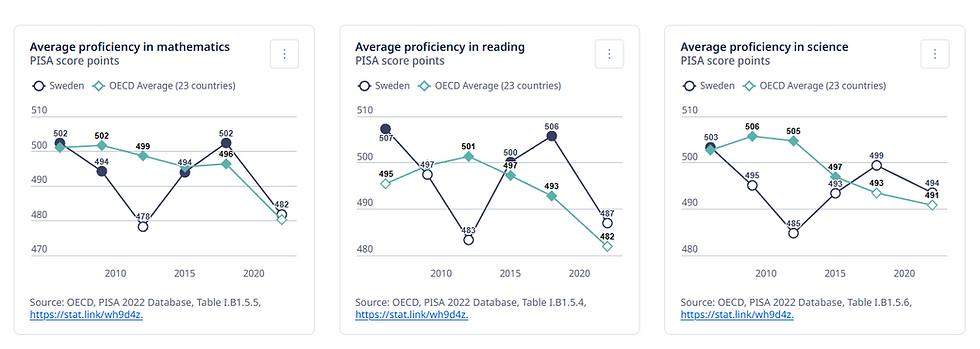


It is clear from looking that these graphs that Norway, Sweden and Denmark experienced a decline in PISA scores from 2010 onwards. This was most dramatic for Norway, particularly in terms of mathematics. Sweden's decline appeared to be halted in 2018, before continuing again in all three areas. Denmark experienced a sudden decline from 2018 onwards.
Korea also experienced a drop in mathematics scores, although this seems to have been arrested from 2015 onwards. Reading and science scores dropped, but remained comparatively high. The UK saw a gradual decline, with a steeper drop in 2020 across all three areas, but scores remained comparatively high.
Understandably, Norway, Sweden and Denmark were concerned by the PISA results over this period. Many commentators made the link between increased use of digital devices in school and lower PISA scores. Since the publication of these results, Norway, Sweden and Denmark have all initiated a change in school digital strategy, investing in textbooks and moving to remove access to digital devices among children. But if this is in response to concerns, including declining PISA scores, is this the right approach, and is it justified on the evidence available?
Examining data on technology use
The OECD publication, 'Education in Sweden, A Diagnostic Review with Analysis of PISA 2022 Results' (link) offers thorough and helpful insights about the implications of the 2022 PISA results in relation to use of technology in Swedish schools.

This study recognised the surge in investment in digital resources over the last ten years, accelerated by the COVID pandemic. The study recognised a key consideration, that despite the scale of the expansion of use of digital technology in schools, limited data is available, stating,
"Despite a growing body of rigorous research on the use of digital technologies in schools, generalisable evidence concerning their impact on students' educational development is limited, given the highly context-dependent and diverse use of digital resources in schools."
This observation is important and is explained throughout the publication. It recognises that use of digital technology varies between schools, districts, regions and countries. Even in a school with a developed digital strategy, different teachers will use the same technology to different effect. Terms like 'artificial intelligence', 'screentime' and 'digital devices' mean different things depending on who you speak to. Children playing an educational game and children using a laptop to program a soil moisture sensor are both engaged in screentime, but with different results developing different aspects of cognition.
By evaluating schools purely on how many screens are in the building, rather than how those screens are used, policymakers run the risk of misdiagnosing the problem. The rest of the report helps understand whether this is the case in Sweden.
The OECD report referenced a report by Forsstrom et al. 2025, (link), which as reported by the OECD, found that,
"Effective digital integration is characterised by structured tasks aligned with curriculum standards, the thoughtful integration of tools linked to learning goals, robust teacher support for students and their learning process, a balanced use of digital and analogue methods, personalised learning opportunities, collaboration and classroom management that builds on relational aspects such as trust, mutual respect and positive teacher-student relationships."
This observation details so many of the things that are important to effective use of technology in schools. Above all, it places learning and the curriculum at the forefront, before the tasks or tools that are selected to accomplish these. Schools that use digital technology effectively develop a curriculum that carefully considers children's developmental needs, required knowledge and understanding and need to express themselves through meaningful work.
The reference to the learning process points to the value of metacognition (how students understand their own thinking). It encourages us to examine the role that technology plays in advancing or in some cases, hindering, effort, thinking and cognitive development.
References to personalised learning highlights an areas where technology demonstrates promise, in being able to offer resources tailored to the needs of children at different stages of their learning. This can be in the form of tailored, digital resources being made available, including videos, scaffolds for work and extension materials, perfectly mapped to children at different stages of development.
The OECD report cautions when interpreting the PISA data, stating,
"While PISA data provides rich insights into use of digital technology in Swedish schools, it also has methodological limitations that policy makers need to be aware of when interpreting the data presented in this report. Most importantly..., the associations presented throughout the chapter reflect statistical correlations and should not be interpreted as causal."
PISA data undoubtably shows a decline in areas of areas of academic achievement in Norway, Sweden and Denmark. This correlates to a period when digital devices were introduced into school in this region.
However, correlation is not causation. Two questions arise:
1) Did the introduction of digital technology cause the overall decline?
2) Was the decline because of technology itself, or because of the way that it was introduced and managed?
As the OECD report alluded to earlier, answering the second question is incredibly difficult. The diversity of how the same technology can be used by different teachers and institutions makes drawing overall conclusions a complex task.
The rest of the OECD article contains valuable data and conclusions, including about device availability and frequency of device use at school.
The report concluded that,
"The availability of digital devices in Swedish schools is associated with slightly higher levels of mathematics performance once students' and schools' socio-economic profile is accounted for...Having access to a wider range of digital resources at home is associated with higher levels of performance for advantaged, but not disadvantaged students."
This conclusion again, points to the complexity of the question of digital device use. Availability of devices is just one factor, socio-economic profile, availability of devices at home and pupil's level of advantage also contribute to achievement. As discussed earlier, even availability of devices in a school can mean different things, depending on the ways that the devices are used.
One of the most interesting observations of this report was the "curvilinear relationship" described between device use and attainment. The report stated,
"In most OECD countries, the time that students reported spending using digital resources for learning at school has a curvilinear relationship with their performance. That is, while students who spend a moderate number of hours per day using digital resources for learning activities at school school higher in mathematics than students who spend no time on such devices."

The report also compared this to Finland, stating,
"Student in Finland show an even stronger drop in performance associated with intensive use of digital resources in mathematics lessons that Swedish students."
Results form both Sweden and Finland seem to point to a detrimental effect on mathematics attainment when children use screens for long periods of time.
Of particular significance in the report are the findings on devices and distraction within lessons. The report stated,
"Students who use digital devices can easily be tempted to multitask, shift their attention to other information or software available on the devices, or use their internet browsers for non-academic activities when using these devices."
Distraction is arguably, not an issue that is raised often in discussion about the merits of using digital technology in the classroom. Much of the current discussion, rightly, focuses the impact of cognitive development when using technology and the effectiveness of digital tools for learning, compared to analogue tools. But the classroom reality is that digital technology can be distracting, even in terms of waiting for software to load, devices to be handed out or logins to be checked. Again, drawing overall conclusions about these factors is hard due to the differences in how schools account for, and prepare for these issues.
Addressing wider developmental concerns
As well as addressing concerns highlighted by academic performance, Nordic countries are acting to address perceptions of use of technology interrupting wider aspects of children's development.
In 2025, the Norwegian Government published the white paper, 'Safe upbringing in a digital society,' (link).
This report laid out the government's objectives for keeping children safe in a digital society. It included considerations around screentime, privacy, online content, bullying and pitfalls relating to use of artificial intelligence by children.
The main concern raised about children's use of artificial intelligence was not, in fact, loss of cognitive development through answers being provided by AI tools. Instead, the report was concerned by children forming 'parasocial' relationships as children potentially bonded with AI tools. Th report stated that children were at risk of manipulation by AI tools and that children had developed relationships with AI tools which were incapable of empathy or understanding.
This concern points to a risk more serious than even cognitive decline, suggesting that children's safety and wellbeing are at risk if they are given access to tools without sufficient understanding and capability to critique.
On 19th June 2026, the Norwegian government published a press release, stating concerns that use of generative AI by primary children was affective their cognitive abilities. (link)
The press release stated,
"Several rounds of international surveys such as PISA and PIRLS show large drops in Norwegian students' basic skills, such as reading, writing and arithmetic. Uncritical use of generative AI can lead to students skipping important stages of learning."
The release went on to state,
"Our children must learn to find their own answers, not have them ready made by AI. They do not have the academic foundation, the critical reflection and self-regulation needed to use AI in a good way. They must learn to read for themselves, write for themselves, do math for themselves and think for themselves."
Coupled with this, the Norwegian government is also legislating to provide access to physical books. The press release stated,
"We are now sending a clear signal to municipalities that they must prioritise physical books to a greater extent."
The Norwegian approach aims to address all aspects of children's development, recognising that development takes place in stages and that academic skills, thinking skills, critical skills and regulatory skills come before the development of skills relating to use of technology.
What is the Nordic approach not doing?
The Nordic approach does not equate to removing technology from schools.
It also does not equate to a ban of AI in schools. The Norwegian press release stated that children in grades 1-7 will not be generally be given access to AI. In grades 8 - 10, AI can be used cautiously and gradually, depending on teacher competence. In upper secondary education, students will use AI appropriately to prepare them for further education and work.
In fact, the aforementioned white paper, 'Safe upbringing in a digital society,' stated,
"Artificial intelligence (AI) will play a significant role in pupils' future. Schools must prepare them for this...Schools must equip pupils for a future involving AI, enabling them to act with ethical awareness and critically reflect on the consequences of technology for individuals and society."
In Sweden, physical reading materials are replacing screens as the primary learning tools. Technology is, however, still being used in schools to teach children digital skills. Children learn research and media literacy, being taught how to safely search for information and navigate digital environments safely. Children are also introduced to computational thinking and learn programming logic.
The Swedish National Agency for Education (Skolverket) is emphasising that foundational literacy (reading physical books by hand) is crucial for memory retention and deep focus. This corresponds to research about retention via printed materials and the increased cognitive load experienced when reading on a screen.
Denmark is also not executing a 'blanket ban' of technology, but instead shifting its focus from classroom digitlaisation, to tactile, immediate, text-based analogue instruction. Denmark's Ministry of Children and Education (Borne-og Undervisingsministeriet) has issued a 12- point national recommendation for screen use (link), which states that schools must block access to non-educational "entertainment" on school networks and protect "analogue learning" and teacher - led digital tools. Crucially, the strategy states,
"The agency also recommends that schools be aware of when it makes academic sense to use digital learning materials, and that they make room for analogue learning. A new report commissioned by the Danish Health Authority points out that it affects children and young people's ability to concentrate and disrupts their academic performance when they use access to private screen use during teaching."
The measures being put in place in Norway, Sweden and Denmark, while similar, should be treated in isolation and examined upon their own context, strategy and rationale. What all three have in common is a recognition of the value of analogue methods and the need to develop all aspects of children's development, including digital skills.
Conclusion - what does this mean for the future of devices in schools?
The Nordic decision to limit use of technology can be viewed as a regressive step. It can seem counterintuitive to limit children's access to devices and their ability to use digital tools at a time when learning digital skills is so important. Commentators have been particularly concerned about the mistaking of correlation of decline, as measured by PISA tests, with causation.
However, the Nordic strategy is less an absolute rejection of digital tool and more a conscious, strategic re-embrace of analogue learning. Norway, Sweden and Denmark have all made a conscious decision to re-embrace physical methods of learning in circumstances where these are the best tools for children's reading, cognitive development and concentration.
The data from the OECD PISA analysis suggests a curvilinear relationship between use of technology and success in mathematics. However, as discussed, terms like 'technology', 'artificial intelligence' and 'screentime' mean so many different things in practice, that it is difficult to use these terms to draw conclusions. Instead, far more precise discussion is needed relating to the exact uses of technology in schools.
What other countries can learn from the Nordic approach is the value of choosing tools based on prior-established educational and developmental outcomes. Nordic countries have evaluated certain developmental priorities and decided that the tech tools they have are not right for all of them. At the same time, digital literacy and computational thinking are still being taught using digital tools. Whether other countries decide to come to the same, or different conclusions will depend on the priorities they set, the tools they choose, and most importantly, the way that teachers are trained to use them.


