
Apps for Good

Updated: Sep 28, 2025
Apps for Good is one of the best opportunities available for young people looking to develop interest, experience and understanding of coding and app design. In this blog, we will explore the concept of Apps for Good, the process of entering and the benefits of school children following this program.
What is Apps for Good?
Apps for Good is hosted on the website: https://www.appsforgood.org/ . It is a UK based charity that provides free courses for teachers and children in schools. Through following these courses, children are introduced into the process of app development and design. They eventually have the opportunity to submit their app for review by judges in a showcase.
The Apps for Good process
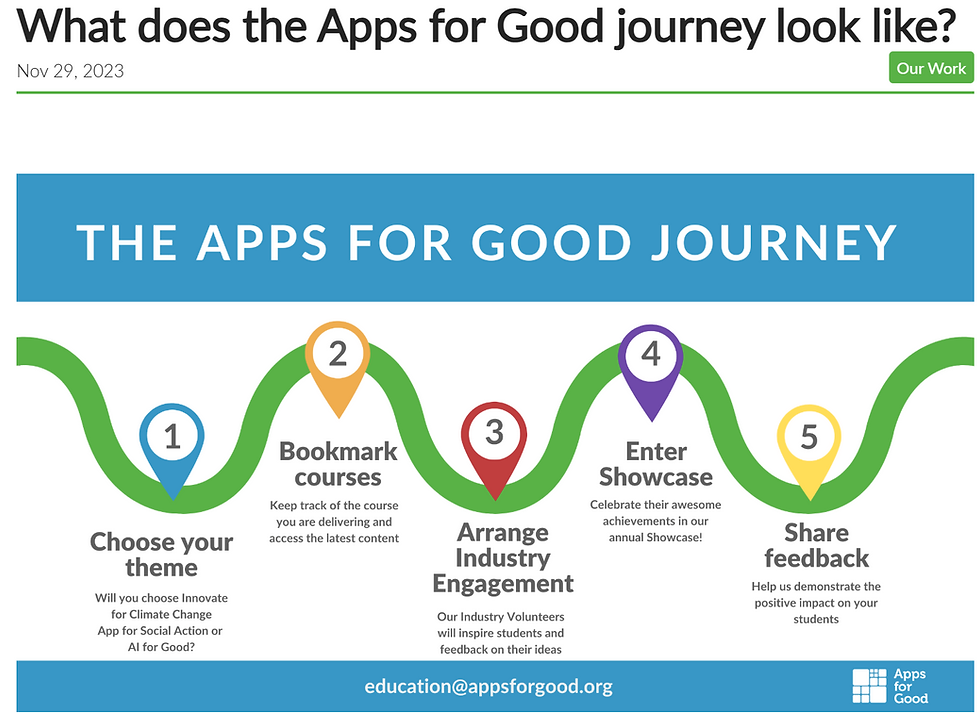
The deadline for submitting apps for the showcase is usually in early May. This means the children have most of the academic year to work on the idea for their app, carry out research, build their app and develop the promotional video that accompanies it. There is a timeline for last year's competition on the showcase of the Apps for Good website: https://www.appsforgood.org/showcase
Following one of the Apps for Good courses guides children through the process of organising a team, selecting an idea to develop, carrying out market research, event-based programming, making the app accessible and use of programming logic within the app. Ideally, the Apps for Good project would span several subjects, incorporating elements of Maths, English and Humanities, as well as coding and app design. Taught in this way, the Apps for Good program could tie together learning across the curriculum as children work on a real-world project.
The reality for many schools will be that they cannot devote time from multiple subjects across the school year to the Apps for Good competition. It is possible to deliver the Apps for Good content through Computing lessons, although again, the curriculum will need to be matched to the topics covered in the Apps for Good process.
Children should keep evidence of their 'wireframe' designs, where they plan out the app on paper. They should also collect the research they do for their app, particularly the problem that the app aims to address. It is also important that children leave enough time to create a good quality promotional video explaining how their app works and their rationale for making it.
It is likely that children will need time outside of lessons to work on their app. This may be through attending lunchtime computer clubs or after school clubs. Children should also be encouraged to work on their app at home - they are able to do this through singing into App Lab in code.org where they will develop their apps. I have written a separate blog post about App Lab here.
I have found it beneficial for children to do the 'Into to App Lab' course in code.org in the academic year before they enter Apps for Good. They could, for example, do this introduction course at the end of Year 5 and enter Apps for Good in Year 6. It is much easier for them to design an app if they have a concept of the type of apps that they will be able to produce.
Benefits of Apps for Good
I cannot overstate the motivation that the Apps for Good competition gives children in their programming. All of a sudden, coding is a valuable tool to solve a real-world problem. I have seen children show massively increased interest in building apps, compared to other programming work they have done.
The Apps for Good courses provide ideas to link app design and programming with entrepreneurial skills like market research and industry engagement. It also links to social and climate issues, encouraging children to think about positive ways that technology can affect the world.
Overall, Apps for Good is something that I would definitely recommend schools try staff at Apps for Good are incredibly supportive and encouraging and the process is always a positive one, particularly for children that enter the showcase. Don't feel as though you have to get it right the first year that you enter, but the experience will undoubtably be a positive one that you and your students will learn from.


